


본문
Learners Leveraging Generative AI for Creative Problem Solving: Focusing on the PISA 2022 Creative Thinking Problems

By prof. Hyo-Jeong So
Department of Educational Technology
PURE Research Profile
hyojeongso@ewha.ac.kr
Does generative artificial intelligence (GenAI) enhance or hinder human creativity? In today’s rapidly changing society, individuals are increasingly confronted with complex problems that cannot be solved through fixed, pre-existing knowledge alone. Standardized solutions are often insufficient, and in many cases, clear answers do not exist. Consequently, creative problem solving (CPS) has emerged as a critical competency for learners to adapt and succeed. Reflecting this shift, the World Economic Forum identified creative problem solving as one of the top ten essential skills for future talent, and PISA 2022 introduced a creative thinking assessment. At the same time, GenAI tools such as ChatGPT are reshaping conventional understandings of creativity, prompting ongoing debate about whether GenAI enhances or constrains human creative capacity.
Despite growing interest, empirical research examining how learners actually use GenAI during creative problem solving remains limited in educational contexts. To address this gap, Prof. Hyo-Jeong So and Chohui Lee conducted a study titled “Learners leveraging generative AI for creative problem solving: Focusing on the PISA 2022 creative thinking problems,” investigating how learners engage with GenAI when solving problems that require creative thinking.
The study examined how 38 middle school students in Korea (aged 15) interacted with ChatGPT while solving social and scientific problems drawn from the PISA 2022 Creative Thinking Assessment. The research explored domain-specific patterns of GenAI use and identified differences between high- and low-performing students in their prompting strategies. To achieve this, the research team developed a comprehensive coding scheme to categorize student prompts according to CPS dimensions, conducted network analysis to visualize prompt transition patterns, and applied sequential pattern analysis to identify recurring prompting sequences. Student performance was assessed using a rubric adapted from the PISA 2022 creative thinking criteria.
The findings revealed clear differences in GenAI usage across both problem domains and performance levels. First, students adopted distinct engagement strategies depending on the problem domains (see Figure 1). In social problem solving, students tended to rely heavily on ChatGPT’s suggestions, frequently using Solution Automater (SA) prompts that directly requested fully developed solutions. In contrast, scientific problem solving involved a more balanced integration of student-generated ideas and AI-generated suggestions.
Second, substantial differences emerged between high- and low-performing students in their prompting strategies (see Figure 2). High-performing students employed a wider range of prompt types and strategically combined them throughout the CPS process. They frequently evaluated ChatGPT’s outputs and iteratively refined their prompts. By contrast, low-performing students relied on repetitive prompting patterns and accepted AI-generated suggestions with minimal modification or originality. In particular, both groups used a similar number of prompts, approximately 11 to 12 prompts per student on average, indicating that CPS performance with ChatGPT depends more on the quality of the prompts than on their quantity.
This study responds to the growing need to understand learner–AI collaboration in educational contexts where creativity and problem solving are essential competencies. By providing empirical insights into learners’ processes of engaging with GenAI for creative problem solving, the study underscores the central role of learner agency in GenAI-assisted learning. The findings demonstrate that proactive human involvement, such as strategic prompting, critical evaluation of AI outputs, and balanced integration of human and AI ideas, is crucial for realizing GenAI’s educational potential. From a practical perspective, these insights offer valuable guidance for educators and instructional designers seeking to integrate GenAI into STEM learning in ways that genuinely enhance students’ creative thinking. Ultimately, the study highlights that GenAI is most impactful not when it automates creativity, but when it supports learners in becoming more intentional, reflective, and agentic problem solvers.
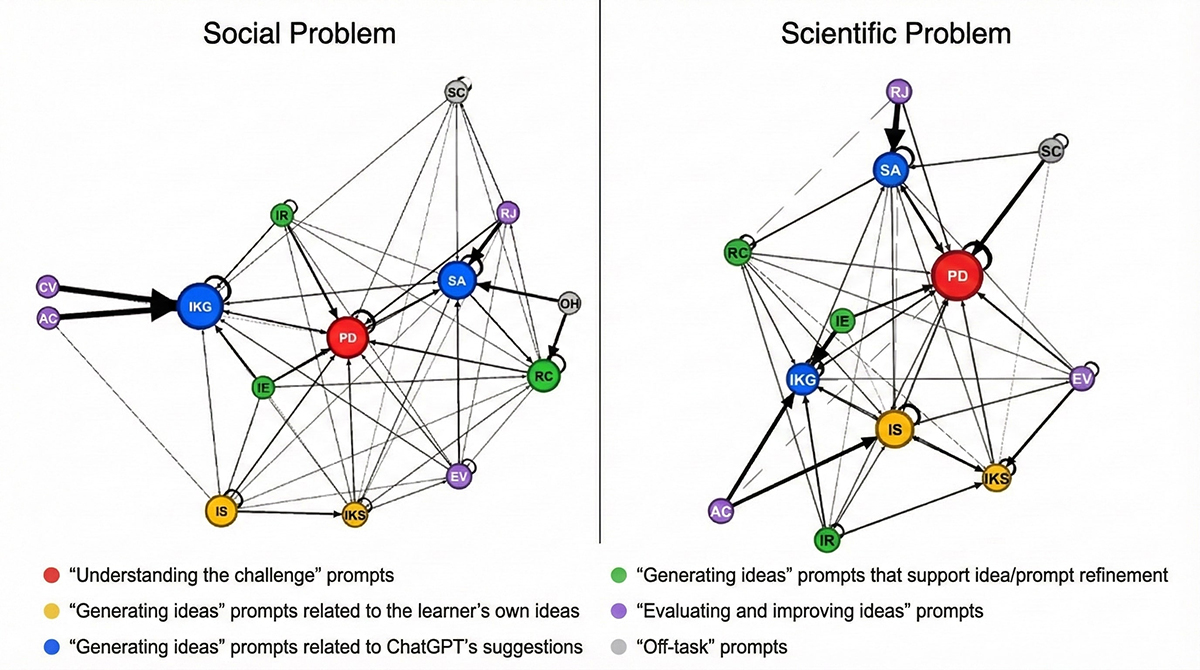
Figure 1. Learners' prompt usage patterns in social and scientific problem domains
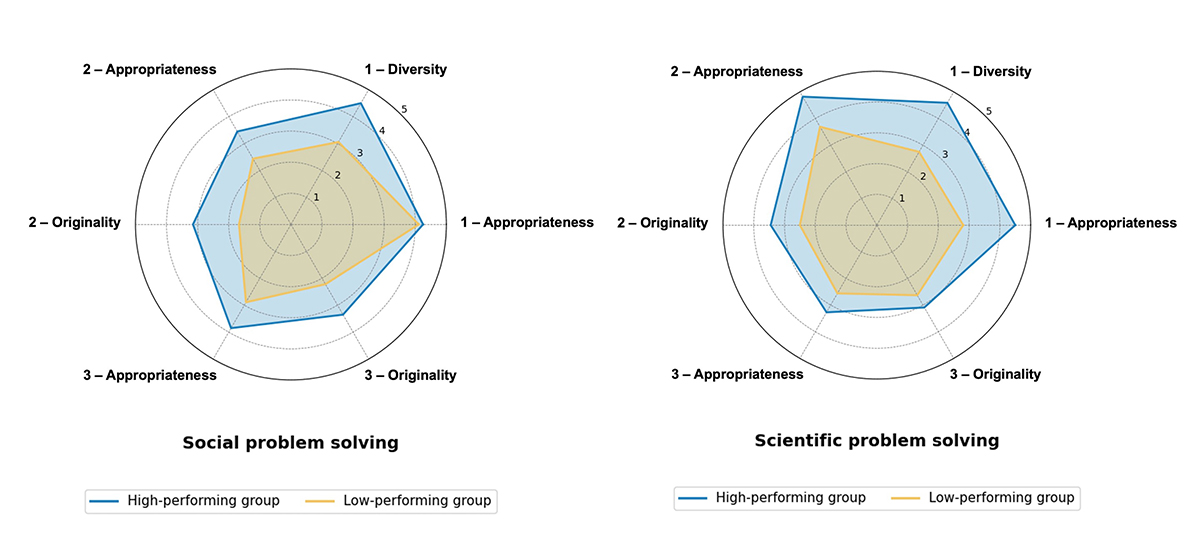
Figure 2. Comparison of CPS scores in high- and low-performing groups
* Related Article
Chohui Lee, Hyo-Jeong So, Learners leveraging generative AI for creative problem solving: Focusing on the PISA 2022 creative thinking problems, Educational Technology & Society, 28(4), 241-258, 2025.

